




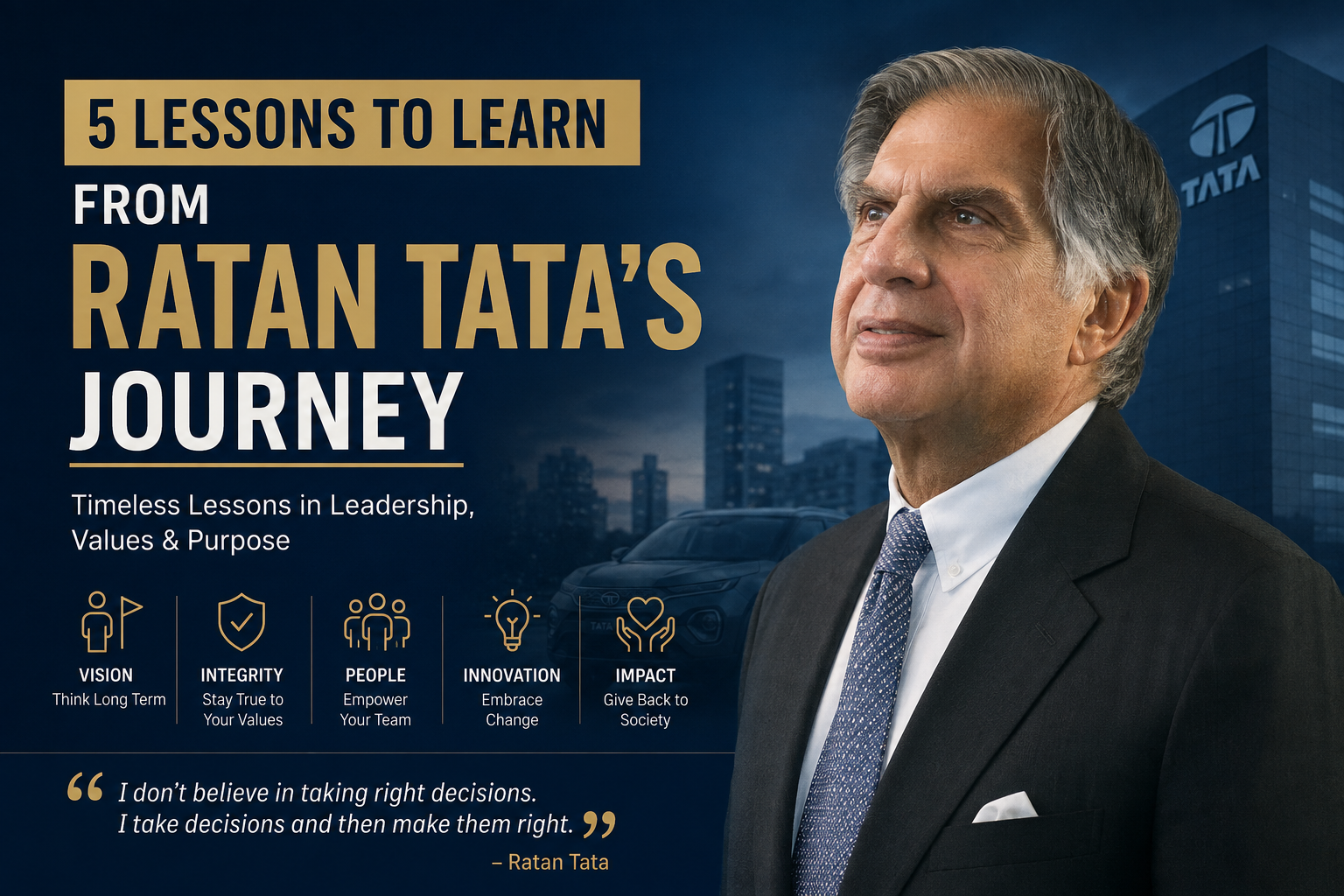
5 Lessons to Learn From Ratan Tata’s Journey: Leadership, Success, and Life
Some leaders build successful companies. Others build institutions that continue to inspire generations.
Ratan Naval Tata belongs to the second category.
Known for his calm personality, humility, business vision, and commitment to social responsibility, Ratan Tata became one of India’s most respected business leaders. He joined the Tata Group in 1962, worked across several Tata companies, became Chairman of Tata Sons in 1991, and eventually guided the group through a period of major transformation and international expansion.
His journey is particularly interesting because it wasn’t simply a story of financial success. Under his leadership, the Tata Group became more globally competitive while continuing to emphasize values such as integrity, innovation, social responsibility, and long-term thinking.
Ratan Tata passed away in October 2024 at the age of 86, but his ideas and leadership philosophy continue to influence entrepreneurs, students, professionals, and aspiring leaders.
So, what can we actually learn from Ratan Tata’s journey?
Here are five lessons that can be applied not only to business but also to career, relationships, leadership, and everyday life.
1. Think Long-Term, Not Just About Immediate Success
One of the biggest lessons from Ratan Tata’s journey is the importance of long-term thinking.
In a world where businesses often focus on quarterly results, instant growth, and quick recognition, Ratan Tata demonstrated the value of making decisions with a much longer horizon.
When he became Chairman of Tata Sons in 1991, the Indian economy was entering a major period of liberalization. The Tata Group itself faced challenges including organizational complexity, bureaucracy, and a rapidly changing competitive environment.
Instead of simply protecting the existing businesses, Tata pushed the group toward restructuring, greater cohesion, innovation, and international expansion.
This wasn’t a short-term transformation.
It required accepting uncertainty and making decisions whose benefits might not immediately become visible.
What does this teach us?
Whether you’re building a company, developing a career, or learning a new skill, meaningful results usually take time.
For example:
- A successful business isn’t built overnight.
- A strong personal brand takes years to develop.
- Expertise comes from consistent practice.
- Trust is earned through repeated actions.
- Financial stability requires patience.
- Great organizations require long-term vision.
Ratan Tata’s journey demonstrates that success isn’t always about moving quickly; sometimes it’s about moving consistently in the right direction.
How to apply this lesson
Instead of asking:
“What will give me results this month?”
Ask:
“Where do I want to be five or ten years from now, and what should I start doing today?”
That change in perspective can completely alter your decisions.
Key takeaway:
Don’t sacrifice long-term success for short-term applause.
2. Let Your Values Guide Your Decisions
One of the most frequently discussed aspects of Ratan Tata’s leadership is his emphasis on ethics and integrity.
Business success can create enormous opportunities, but it can also create enormous pressure. Leaders may face situations where maximizing profits conflicts with reputation, responsibility, or principles.
Ratan Tata’s public legacy is strongly associated with maintaining the Tata Group’s ethical identity while pursuing growth.
In a 2024 statement following his death, Tata Sons Chairman N. Chandrasekaran described Tata’s leadership as being characterized by excellence, integrity, innovation, philanthropy, and humility.
That combination is important.
Integrity isn’t just about refusing to do something wrong. It’s also about developing a reputation where people know what you stand for.
Why integrity matters in business
Imagine two companies.
Company A focuses entirely on maximizing short-term profits.
Company B focuses on profitability while also caring about customers, employees, partners, communities, and its reputation.
Company A may sometimes grow faster.
But Company B has something incredibly valuable:
Trust.
Trust can become a competitive advantage.
Customers trust brands they believe are authentic. Employees want to work for organizations whose values they respect. Investors often look at governance and reputation alongside financial performance.
The lesson for your life
You don’t need to become a billionaire or run a multinational company to apply this principle.
Your personal reputation is an asset.
Be honest when nobody is watching.
Keep promises.
Give credit to others.
Admit mistakes.
Don’t compromise your principles simply because something offers a faster result.
Success becomes much more meaningful when you don’t have to sacrifice who you are to achieve it.
Key takeaway:
Your values should determine how you succeed, not just whether you succeed.
3. Don’t Be Afraid to Take Calculated Risks
Another powerful lesson from Ratan Tata’s journey is that growth requires the courage to take calculated risks.
When Ratan Tata became Chairman in 1991, he inherited a large and complicated organization at a time when India’s economic environment was changing dramatically.
Rather than remaining defensive, he recognized the opportunities created by economic liberalization and encouraged the Tata Group to become more cohesive, innovative, and internationally competitive.
The group’s globalization strategy later included major international acquisitions, including Tetley, Corus, and Jaguar Land Rover.
These decisions involved substantial risk.
But there is an important distinction:
Risk is not the same as recklessness.
Calculated risk means:
- Understand the opportunity.
- Study the potential downside.
- Gather information.
- Prepare for possible failure.
- Make a decision.
- Learn from the outcome.
This mindset is especially relevant for entrepreneurs.
Many people wait for the perfect opportunity because they are afraid of making mistakes.
But perfection rarely exists.
Sometimes the biggest risk is never taking a risk at all.
Ratan Tata and innovation
The Tata Nano is another example of ambitious thinking.
The project attempted to create an affordable car for Indian consumers and became one of the most recognizable examples of Tata’s willingness to pursue unconventional ideas. Tata’s official biography notes that the Nano was launched in 2008 after the small-car project was pursued with determination.
The project did not become the commercial success many expected.
And that’s important.
A lesson doesn’t become useless simply because an experiment doesn’t produce the desired outcome.
Failure can still create value
The Nano experience can teach entrepreneurs an important principle:
A failed outcome doesn’t necessarily mean a failed effort.
You may gain:
- market knowledge,
- customer insights,
- technical expertise,
- leadership experience,
- better decision-making,
- and resilience.
The goal isn’t to avoid every failure.
The goal is to learn faster than you fail.
Key takeaway:
Take calculated risks, accept uncertainty, and treat failure as feedback.
4. Stay Humble Even When You Become Successful
Perhaps the most recognizable personal characteristic associated with Ratan Tata is his humility.
He became one of India’s best-known business leaders, yet his public image was remarkably different from the stereotypical image of a powerful corporate executive.
The Tata Group describes his leadership style in terms of grace, quiet dignity, humility, and an aversion to the spotlight.
That creates an important lesson:
Your position should never become your personality.
A title can change.
A company’s valuation can change.
Your income can change.
Your popularity can change.
But the way you treat people reveals much more about your character.
Why humility is powerful
Humility doesn’t mean thinking you’re not capable.
It means understanding that:
- You can always learn.
- Other people can teach you something.
- Your team contributes to your success.
- You can be wrong.
- Success doesn’t make you superior to others.
This is particularly important for leaders.
A leader who believes they know everything eventually stops learning.
A leader who remains curious continues to evolve.
How to practice humility
You can apply this lesson in very simple ways:
Listen more than you speak.
Give credit to your team.
Ask questions.
Accept constructive criticism.
Treat junior employees with the same respect as senior executives.
Remember the people who helped you along the way.
Humility makes leadership more human.
And that may be one reason Ratan Tata’s personality continues to resonate with people far beyond the corporate world.
Key takeaway:
Let your achievements make you grateful, not arrogant.
5. Use Success to Create an Impact Beyond Yourself
Perhaps the most meaningful lesson from the Tata legacy is that business success and social impact don’t have to be opposites.
Ratan Tata was deeply involved with the Tata Trusts and philanthropic initiatives involving areas such as education, healthcare, research, agriculture, and community development.
The broader Tata tradition of philanthropy goes back generations.
The Tata Group’s heritage records a longstanding emphasis on education, healthcare, employee welfare, scientific research, and nation-building.
Under Ratan Tata, this philosophy continued to be an important part of his legacy.
The Tata Trusts’ initiatives have supported areas ranging from healthcare and education to community development, while Tata’s own post-chairmanship activities included continued involvement with philanthropic institutions.
Why this lesson matters
Many people define success using numbers:
- How much money do I make?
- How many followers do I have?
- How big is my company?
- What car do I drive?
- How prestigious is my job?
But there is another question worth asking:
“What positive difference am I making?”
Impact doesn’t require billions of rupees.
You can create impact by:
- Helping someone learn a skill.
- Mentoring a younger person.
- Supporting a local cause.
- Creating employment.
- Building a useful product.
- Sharing knowledge.
- Helping your family.
- Volunteering your time.
Your impact doesn’t have to be enormous to be meaningful.
The bigger lesson
Ratan Tata’s legacy demonstrates a broader philosophy:
Success becomes more valuable when it benefits people beyond yourself.
Key takeaway:
Don’t measure your life only by what you accumulate; measure it by what you contribute.
Bonus Lesson: Your Background Does Not Define Your Final Destination
Ratan Tata was born into the Tata family, but simply having a famous surname did not automatically make his leadership journey easy.
He studied architecture and structural engineering at Cornell University, returned to India, and began working within the Tata Group in 1962. He gained hands-on experience in Tata companies before eventually joining the board of Tata Sons in 1974 and becoming chairman in 1991.
His career demonstrates the importance of earning experience before exercising authority.
He didn’t begin his career at the top.
He worked his way through different parts of the organization and encountered both successful and struggling businesses.
That experience mattered when he eventually became Chairman.
The lesson is simple:
Don’t rush to the title. Build the capability.
Ratan Tata’s Journey: A Quick Timeline
| Year | Milestone |
|---|---|
| 1937 | Ratan Naval Tata was born |
| 1955 | Left for Cornell University |
| 1962 | Joined the Tata Group |
| 1971 | Became director-in-charge of Nelco |
| 1974 | Joined the board of Tata Sons |
| 1981 | Became Chairman of Tata Industries |
| 1991 | Became Chairman of Tata Sons |
| 1990s–2000s | Led major restructuring and globalization |
| 2000 | Tata acquired Tetley |
| 2007 | Tata Steel acquired Corus |
| 2008 | Tata Motors acquired Jaguar Land Rover and Tata launched Nano |
| 2012 | Stepped down as Chairman of Tata Sons |
| 2014 onward | Became increasingly involved in startup investing |
| 2024 | Passed away at age 86 |
The timeline illustrates how his career developed over several decades rather than through overnight success.
What Entrepreneurs Can Learn From Ratan Tata
For entrepreneurs, Ratan Tata’s journey offers a particularly useful framework.
1. Build for the future
Don’t create a business solely around today’s trend.
Think about where your market could be five or ten years from now.
2. Protect your reputation
A strong reputation can take years to build and only minutes to damage.
3. Experiment
Not every idea will work.
But experimentation creates learning.
4. Build people
A great organization isn’t created by one person. It is created by talented people working toward a shared objective.
5. Think beyond money
A business should solve a real problem and create genuine value.
Revenue is important, but value creation comes first.
What Students Can Learn From Ratan Tata
Ratan Tata’s lessons aren’t limited to CEOs.
Students can apply them too.
Don’t worry about having everything figured out
Your career can evolve.
Ratan Tata studied engineering and architecture before building his career in business.
Learn continuously
Industries change.
Technology changes.
Markets change.
The ability to learn is therefore more valuable than memorizing one fixed career path.
Don’t fear failure
A disappointing result can become a learning experience.
Develop character alongside skills
Technical knowledge can help you get an opportunity.
Character determines how you use it.
Think about impact
Ask yourself what problems you want to solve—not simply what job title you want.
5 Lessons From Ratan Tata’s Journey — In One Table
| Lesson | What It Means | How You Can Apply It |
|---|---|---|
| Think Long-Term | Focus beyond immediate results | Build skills and relationships for the future |
| Choose Integrity | Never sacrifice values for quick gains | Be honest and consistent |
| Take Calculated Risks | Growth requires uncertainty | Research, decide, experiment and learn |
| Stay Humble | Success should not change your character | Listen, learn and respect everyone |
| Create Impact | Success should benefit others | Share knowledge, help people and solve meaningful problems |
Frequently Asked Questions About Ratan Tata’s Journey
What are the five main lessons from Ratan Tata?
The five major lessons are long-term thinking, integrity, calculated risk-taking, humility, and creating positive social impact. These principles are reflected in his leadership of the Tata Group and his philanthropic legacy.
What made Ratan Tata a successful leader?
His leadership combined business transformation with values such as integrity, innovation, long-term thinking, humility, and social responsibility. During his chairmanship, the Tata Group expanded internationally and pursued major strategic acquisitions.
What can entrepreneurs learn from Ratan Tata?
Entrepreneurs can learn to think long-term, embrace calculated risks, innovate, protect their reputation, and build businesses that create genuine value for customers and society.
Why is Ratan Tata considered an inspirational leader?
Ratan Tata is widely admired because his legacy combines corporate achievement with philanthropy, humility, and ethical leadership. Tata’s official account of his legacy emphasizes his contributions to business, society, education, healthcare, and innovation.
What is Ratan Tata’s biggest lesson for young people?
Perhaps the broadest lesson is that success should be accompanied by character and purpose. Building skills and achieving financial success matter, but how you treat people and what you contribute to society matter too.
Final Thoughts: The Real Meaning of Ratan Tata’s Legacy
Ratan Tata’s journey isn’t simply a story about becoming the chairman of one of India’s largest business groups.
It is a story about how to lead without losing your values.
He inherited responsibility, but he also built his own legacy.
He faced skepticism, but continued forward.
He made bold decisions, including international acquisitions and ambitious products.
Some worked extraordinarily well.
Some did not.
But throughout his career, the broader principles remained remarkably consistent: think ahead, act ethically, remain humble, embrace innovation, and create value beyond yourself.
That is why the lessons from Ratan Tata remain relevant to entrepreneurs, students, professionals, and anyone trying to build a meaningful life.
The most important takeaway may be this:
Success is not only about how high you climb. It is also about what you do with the position you reach.
Ratan Tata’s life shows that leadership can be powerful without being loud, ambitious without being arrogant, and successful without losing sight of humanity.
And that is perhaps the greatest lesson of all.